
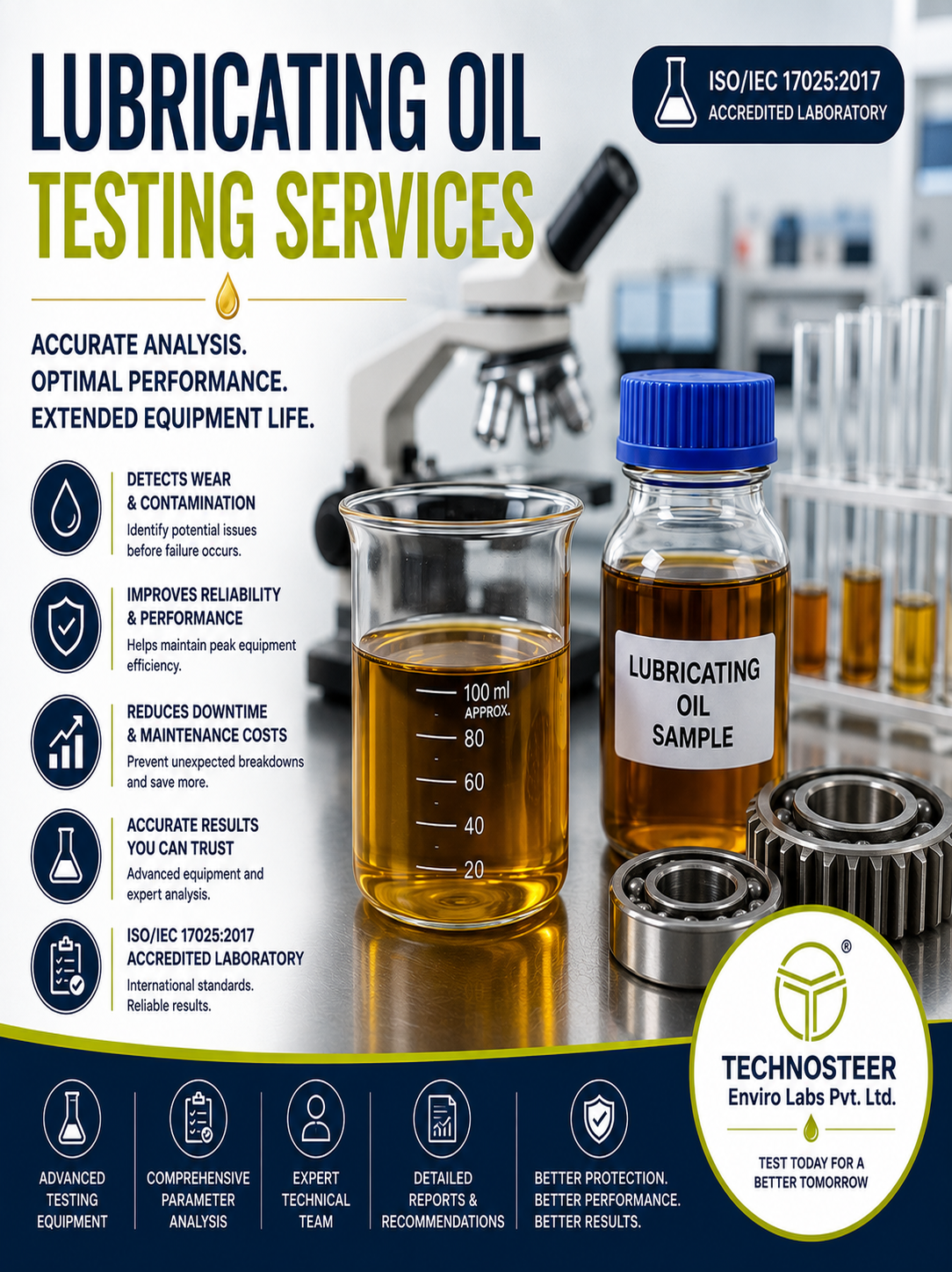
Lubricating Oil Testing Services
Lubricating Oil Testing Services – Oil Condition and Quality Analysis
Lubricating oil testing helps evaluate oil condition, identify contamination, monitor lubricant degradation, and assess selected properties relevant to machinery performance and maintenance.
- Testing of lubricant properties based on the agreed scope
- Possible analysis of viscosity, acidity, water content, and wear metals
- Support for preventive maintenance and lubricant condition monitoring
- Suitable for industrial machinery, manufacturing plants, automotive operations, and maintenance teams
- Test methods, sample requirements, laboratory availability, pricing, and turnaround time confirmed on enquiry
Contact Technosteer Online to discuss your lubricating oil testing requirements and identify the appropriate test parameters for your application.
Lubricating Oil Testing Services
Reliable Lubricating Oil Quality and Condition Analysis
Lubricating oil plays an essential role in reducing friction, minimising wear, controlling heat, and protecting machinery components. Over time, lubricant properties can change due to operating temperatures, oxidation, contamination, moisture, and mechanical wear. Lubricating Oil Testing helps assess oil condition and provides valuable information for maintenance planning and lubricant quality control.
Technosteer Online helps customers enquire about lubricating oil testing for industrial machinery, engines, compressors, gearboxes, hydraulic systems, and other lubrication-dependent equipment. Testing requirements can be tailored to the lubricant type, equipment application, and whether the sample is new or already in service.
Why Is Lubricating Oil Testing Important?
Regular lubricant analysis can help maintenance and quality teams identify changes in oil properties before making decisions about oil replacement or further equipment inspection.
- Monitor oil condition: Evaluate selected physical and chemical properties of lubricating oil.
- Identify contamination: Investigate possible water, particles, or other contaminants using appropriate tests.
- Assess lubricant degradation: Check parameters such as viscosity and acid number where relevant.
- Support equipment maintenance: Use oil analysis results alongside equipment history and operating conditions.
- Verify lubricant quality: Assess selected properties of new oil against applicable specifications.
- Support maintenance planning: Establish a consistent oil sampling and analysis programme.
Lubricating Oil Testing Parameters
The appropriate testing package depends on the lubricant and the intended application. Available tests must be confirmed before submitting a sample.
1. Kinematic Viscosity Testing
Viscosity is an important property that affects lubricant flow and the formation of a protective lubricating film. Testing can help determine whether the oil’s viscosity is appropriate for its intended grade and application.
2. Acid Number Testing
Acid number measurement helps assess acidic constituents in an oil sample. Changes in acid number can provide useful information about lubricant ageing, oxidation, or contamination when interpreted with other results.
3. Water Content Testing
Water contamination can affect lubricant performance and contribute to corrosion, reduced lubrication effectiveness, and other operating problems. A suitable water-content test can help assess the presence of moisture.
4. Wear Metal and Elemental Analysis
Elemental analysis can identify selected metals and other elements in lubricant samples. Depending on the method and equipment, the results may help investigate wear, additive elements, or external contamination. Results should be interpreted in the context of the equipment and lubricant.
5. Additional Lubricant Condition Tests
Depending on the sample and laboratory capabilities, additional testing may include base number, particle contamination, oxidation-related properties, insoluble material, and other application-specific parameters.
Applications of Lubricating Oil Testing
Lubricating oil analysis can support a range of industrial and automotive applications, including:
- Industrial machinery and manufacturing equipment
- Gearboxes and industrial gear oils
- Hydraulic systems and hydraulic oils
- Engines and engine lubricants
- Air compressors and compressor oils
- Bearings and circulating lubrication systems
- Fleet maintenance and automotive workshops
- Industrial maintenance and reliability programmes
The appropriate test methods vary with the lubricant type and the purpose of the analysis.
Suitable for New and Used Lubricating Oil
Testing can be considered for new lubricant quality checks and used oil condition monitoring, subject to the available test scope.
For new oil, testing may help evaluate selected properties against a product specification. For used oil, the analysis may help identify changes during operation, contamination, and selected indicators of equipment wear.
For meaningful condition monitoring, record the equipment identification, lubricant grade, operating hours, sample date, and previous results where available.
Standards and Test Methods
Lubricant testing may use recognised methods such as ASTM D445 for kinematic viscosity, ASTM D664 for acid number, ASTM D6304 for water content, and ASTM D5185 for multielement analysis, where appropriate.
The applicable method depends on the lubricant, requested parameter, and laboratory capability. The current method edition, sample requirements, and acceptance criteria should be confirmed before testing.
How to Request Lubricating Oil Testing
To help determine the appropriate testing requirements, provide the following information when enquiring:
- Lubricant type and grade, if known
- Equipment or machinery in which the oil is used
- Whether the sample is new or used
- Required test parameters or the reason for testing
- Applicable product specification, if available
- Sample quantity and location, where relevant
The testing scope, sample collection instructions, laboratory arrangements, pricing, reporting format, and expected turnaround time must be confirmed before proceeding.
Enquire with Technosteer Online
Looking for lubricating oil testing for industrial machinery, hydraulic systems, engines, gearboxes, or other equipment?
Contact Technosteer Online to discuss your lubricant testing requirements and request information about available tests. Share your oil type, application, and required parameters so that the appropriate testing arrangements can be clarified.
Technosteer Online — Industrial Products and Technical Service Enquiries.
Only logged in customers who have purchased this product may leave a review.
Related products
Industrial Calibration Services
↓38% Original price was: ₹8,000.00.₹5,000.00Current price is: ₹5,000.00.
Marine Fuel Oil Testing Services
↓10% Original price was: ₹10,000.00.₹9,000.00Current price is: ₹9,000.00.




























Reviews
Clear filtersThere are no reviews yet.